Saturday, February 11, 2006

Blogger problems

Over the past week, Blogger has been thwarting my attempts to enter information, ESPECIALLY pictures. It doesn't even recognize the last post, so I can't add pictures to it. Like this one...


HEY! Looks like it's fixed.

I'd better get typing... there's stuff from two weeks ago to be blogged.

Thursday, February 02, 2006

Trick-taking aggression


Rachel drifted by, and she tends to get excited over the games. She a game-playing badger! She wants to know all about all the games. I finally managed to get her focused on Rage for a few seconds, and we decided to play. They say you can play it with 2 people, but you really need 3 to make it worth while. Selena was at the Campus Life table right next to us, so we sat her down and the learning began.

Rage is a trick-taking game, much like Spades or Hearts. But, unlike those games, you have a limited number of cards in your hand. The first round starts with 10 cards, then 9, then 8,.... all the way down to having only one card.

Also, there are a few special cards: there's a couple Jokers, a card that changes trump, a card that eliminates trump, a card that gives the trick-taker +5 points, and card that gives the trick taker -5 points. So, there's some interesting twists and turns as the game goes on.

After the cards are dealt and the initial trump is revealed, players bid on how many tricks each player thinks he/she can win. You have to get it exactly... if you get your bid exactly, you get 10 points, if you are over or under, you lose 5 points. You also get one point for any trick taken, whether or not you made your bid.

Here's how the game went:
cards in handRACHELSELENACHRIS
10-2-3-1
912-46
84-4-2
78-413
6121212
511-43
4-5-211
3-511-3
2-3-510
1-51011
TOTALS FOR THE GAME
27760


Rachel was winning for most of the time, but had some bad luck at the end...

Chris wins!

Back on the Path


Sean had a little more time, and another good game to learn in a minute or two is Tsuro. It also is another Asian-looking game, simply to learn, and the basic dynamics is the laying of tiles and creating paths, so it seemed a natural to follow Ta Yu.

Sean picked it up as quick as he adapted to Ta Yu, and we got down to business.

Sean managed to back himself into a corner... this is a bad situation in Ta Yu -- staying in the center of the board as much as possible is a better idea. But sometimes you just can't help but be squeezed to the edge.

Sean left the board first -- Chris wins!

Go with the flow...


The first game we played at the Welcome Back Bash was Ta Yu. I (Chris) had bought this game the day before (Monday) on the way into work. I had seen it at a small game shop called "Hero Town" the day before that, and did some research -- I found that it was a highly rated game, and rather hard to find. I decided that the $60 price tag was palatable (it was helped by the fact that I had a $10 gift certificate).

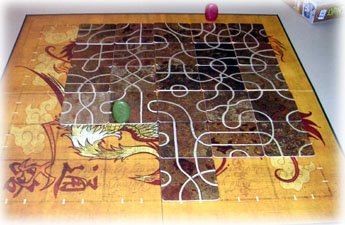
Ta Yu is a simple tile-laying game, with tons of strategy. It takes about a minute to explain the rules of the game, but the gameplay proceeds with endless variety. The first thing that will grab you will be the elegant beauty of the game... long, sinewy dragons surround the border, and the thick, mah-jongg-like tiles are engraved with simple lines that represent channels of water.

The game is really designed for two players -- it can easily be played with two teams of two. You can play the game with three players -- player 3 being one intended to simply thwart the progress of the other two, which would probably introduce a strange dynamic. There is enough frustration in the two player game -- a thwarting player would probably make ones head explode.

Sean stopped by, so Chris and Sean played the two player game of Ta Yu.

One player plays in a sort of "North-South" direction, and the other plays the "East-West" direction. Each player is trying to divert streams of water in his/her directions. There is a good blend of directly (and desperately) trying to wrangle the streams in your own direction while trying to redirect the streams away from your opponents directions. There is a good blend of offense and defense.

Once there is no place for a player to lay down a tile, the game ends, and scoring begins. The person playing North-South counts the number of outlets on the North side and multiplies that by the number of outlets on the South side. The other player does the same for East and West. There are 3 spots on each side that count as two outlets.

Sean had 6 on one side and 4 on the other -- 6 x 4 = 24
Chris had 8 on one side and 8 on the other -- 8 x 8 = 64.

Chris wins!

Ta Yu -- simple, beautiful, strategic, fun. Possibly the most expensive game I've bought -- so far as I can tell, after just one game: worth every penny.

Welcome Back Bash - Spring 2006


We set up a table for the college's Welcome Back Bash. We loaded the table up with dozens of the most colorful and intriguing games.

We were just one of a couple dozen tables, and we started out on a table sort of tucked back in the corner. With some coaxing from Campus Life and the Chess Club (the tabl next door), we moved the table more towards the hub. Actually, we ended up right to the free subs and sodas -- a good place to be.

A couple people drifted by, and then folks started sitting down to play.

The welcome back bash started at 11:00, and finished up around 3:00. The gamers left at around 6:15, when maintenance had to put our table away.

It was a good day.

Must... play... the... word card game...


Just when I thought the game day would be over, Danielle and Igor came over, with Matt in tow.


A game of Quiddler was demanded, and I easily obliged.


We played a 4-player game of Quiddler, with Matt, Danielle, Chris, and Igor.

And, as always, we recorded the results.

MattDanielleChrisIgor
(nothing) = 0DO = 5RAY = 11AIM = 9
GOAL = 13PI + EX = 32ID = 0LENT = 13
HEAR = 9CELL = 24ONE + ERR = 21JOG + ON = 28
MINOR = 17BAD + JUT = 35CLUTTER = 37PUG + ASH = 28
ERGO + OAF = 20MY + FINE = 20THAW + HOSE = 35THEY + TURN = 32
FINER + JUG = 43THEM + QUART = 29IVY + OTTER = 24RAIN + QUOTE = 40
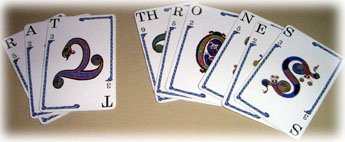
HERE + IN + QUIZ = 58DO + SAME + EGG = 33RAT + THRONES = 41YAWNS + HAZE = 49
MAN + LAW + SOON = 39THY + THY + THE + SON = 57JINX + NEE + ERR = 53CUE + QUIET + MAT
The totals for this game of Quiddler
199235222249


Igor wins!!

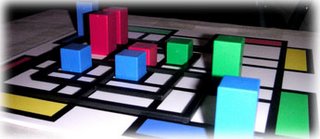
It's like playing a Mondrian painting.


It's been a long day of gaming! I think this was our longest game day yet... Only Jay and I (Chris) remained. We were just sitting there talking when Don from Campus Life came over and asked to play a game. You don't have to tell us twice -- that's why we're here!

I had bought a game called Ido that morning on the way into work. I had gone over the directions, and messed with the pieces, but hadn't played it yet. I was obviously itching to play my new game!

Ido is an interesting game -- in its roots, it is as simple as Parcheesi or Sorry!, you have pieces in your color. You need to move your pieces from a start place to an end place before your opponent can. But that is where any similarities end.

The main board is an irregular grid -- it's not like a chessboard, some squares are smaller than others. And it has a second part -- there is a grid that sits on the board; it looks a little like a square stove burner.

During your turn, you have 3 options: introduce a new piece onto the board, move your piece(s) on the board, or shift the grid, changing the pattern of squares on the board.

You have 2 kinds of playing pieces -- a short cube (think of it as a 1 x 1 x 1 sized cube), and a taller piece (think of that as a 1 x 1 x 2 solid rectangle). The short cube can only move onto 1 x 1 squares. The tall piece can only move onto 1 x 2 squares. As the grid shifts, the size (and shape!) of the possible places to move on the board changes.

If you choose to introduce a new piece, it must start on a legal space -- depending on how the board is a arranged you may not even b able to move a new piece onto the board.

If you choose to move your pieces on the board, you have to follow the legal spaces described above. You get to move a number of spaces equal to the number of pieces you have on the board. If you have 3 pieces on the board, you can move three spaces -- and you can divide those moves however you wish (you can move one piece 3 spaces, OR one piece can move 2 spaces and another piece 1 space, OR you can move all three pieces 1 space each).

If you choose to move the grid, you can shift it one space in any direction, as long as that small grid stays within the confines of the main board. Shifting it may push pieces off the board -- a piece getting pushed off gets returned to its owner and must need to be reintroduced. If the piece gets pushed off into the exit area of a player, that piece instead counts as one that has successfully finished its course through the board.

It all sounds a little strange at first, but the gameplay makes sense once you begin to actually play the game.

Don, Jay, and Chris played a 3-player game of Ido.

We chose to play a short game -- the winner is the one who gets 3 of his/her 6 pieces off the exit wins. You can play a longer game by requiring a greater number of pieces off the board.

Don will be known as "The Annihilator" in Ido -- his first move consisted of knocking a piece from both Chris and Jay of the board. He went on to eliminate 5 pieces from the board throughout the game. In comparison, Chris eliminated one piece, and Jay didn't EVER knock a piece off the board.

Chris got a piece off first, but Don and Jay swiftly managed to do the same. After a bit of a struggle, Chris got a second piece off the board, and he was feeling pretty confident. He was blindly try to push to board top allow him to get off the board, and in shifting the board made it so Jay had 2 of his pieces within 2 spaces of the exit. Since he had 4 pieces on the board, he got them both of in a single turn.

Jay wins!!

I like Ido -- can't wait to play it again.